

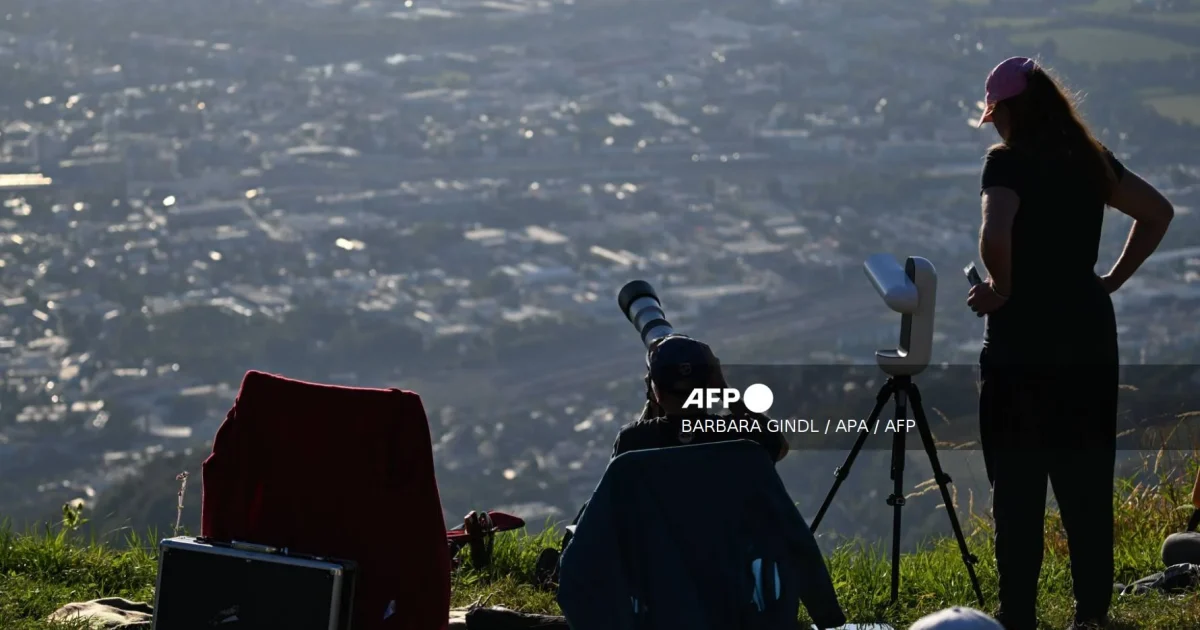
EDINBURGH, UK — A partial solar eclipse captivated observers across the United Kingdom and parts of Europe on Wednesday, with the Moon gradually obscuring the Sun.
The celestial event became visible in Edinburgh around 18:28 BST, with its peak expected at approximately 19:06 in the Scottish capital. Reports from Calton Hill in Edinburgh described the Moon appearing to "take a bite out of the sun," while sunspots were also observable through telescopes.
The eclipse was already underway in parts of Iceland and Greenland, and other European nations were anticipated to experience a total solar eclipse. In most of the UK, over 90 per cent of the Sun was expected to be covered by the Moon, marking the most significant solar eclipse visible from the country since 1999.
Large gatherings of people congregated at viewing spots throughout the UK, and specialized eclipse glasses reportedly sold out in several areas. The phenomenon began earlier in the northernmost part of mainland Russia around 1700 GMT, creating an eerie twilight as only the Sun's outer corona remained visible.
As the eclipse traversed Greenland and Iceland, excitement grew in Spain. The narrow path of totality was set to cut diagonally across the country, from the northwestern Atlantic coast to the Mediterranean Sea, before fading around 1830 GMT. Spain had not witnessed a total solar eclipse in over a century, and mainland Europe had not seen one for two decades.
A solar eclipse occurs when the Moon passes directly between the Earth and the Sun, casting a shadow on our planet and temporarily blocking sunlight. Depending on the alignment, observers can witness a partial eclipse, where only a portion of the Sun is covered, or a total eclipse, where the Moon completely hides the Sun along a specific path.
Experts issued warnings, advising viewers against looking directly at the Sun without appropriate eye protection due to the risk of severe eye damage. The rare event also drew scientific interest, with a group of Irish researchers planning to travel to study the Sun's corona during the eclipse.


Comments (0)
No comments yet. Be the first to share your thoughts!
Leave a Comment