

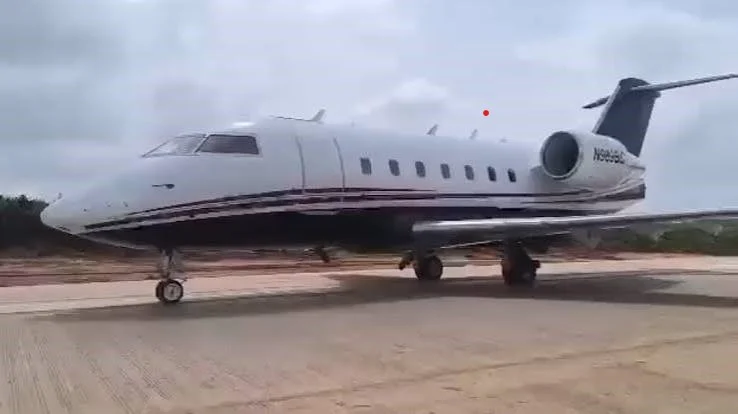
ASABA, Nigeria — The Nigerian Safety Investigation Bureau (NSIB) has stated that the flight data recorder, commonly known as the black box, from the Bombardier Challenger 601 private jet involved in an incident on an Asaba highway, was overwritten before investigators could secure it.
The aircraft, operated by VMO Aero, was reported to have missed the Asaba airport runway on July 10, subsequently landing on a concrete road in Ogwashi-Uku, Delta State. This unusual event raised immediate questions regarding the circumstances leading to the landing and the actions of the flight crew.
During a virtual media briefing on Friday, NSIB Director-General Alex Badeh explained that the aircraft was flown back to Lagos before investigators reached the scene. This return flight, he noted, resulted in the overwriting of crucial flight data stored in the recorder.
Mr. Badeh elaborated that flight recorders utilize continuous circular memory systems. When the storage capacity is reached, new data replaces the oldest information. Consequently, the return flight to Lagos meant that critical data pertaining to the Asaba incident was no longer available.
“The rule allows them to have a 26-hour electric recorder but we discover that it only recorded for about two hour of low quality, from when the aircraft took of from Lagos, landed in Asaba and went back they have overwritten everything that happened within that that time,” Mr. Badeh stated. He added that while this makes the investigation more difficult, the NSIB is exploring other methods to retrieve the necessary data.
The NSIB boss cautioned against premature conclusions that the operators deliberately destroyed evidence. He emphasized that the investigation is ongoing to determine the exact sequence of events. Mr. Badeh also highlighted a concern about a prevailing culture among some pilots where they withhold or alter information due to fear of job loss if mistakes are admitted.
He attributed this issue to a lack of trust between flight crews and safety investigators. “The crew don’t trust NSIB; they are scared of losing their jobs. It is a major problem we are dealing with. We do not recommend punitive sanctions, and we constantly assure crew members that nobody should be penalised for telling the truth,” he said.
Beyond the Asaba incident, Mr. Badeh also voiced concerns regarding the financial challenges confronting the NSIB. The Bureau is opposing a proposal from the Nigerian Airspace Management Agency (NAMA) to reduce the NSIB’s share of the five per cent Ticket Sales Charge from six per cent to four per cent. This proposal aims to increase NAMA’s allocation.
The Ticket Sales Charge is collected by the Nigerian Civil Aviation Authority and distributed among various aviation sector agencies. The NSIB currently receives six per cent, which Mr. Badeh described as the lowest allocation among relevant agencies. He warned that a reduction would severely impact the Bureau, which has seen its responsibilities expand to cover aviation, maritime, rail, and road transportation safety investigations.
“We already get the lowest percentage of all the agencies. With this proposed reduction, it’s going to severely affect the NSIB. The Bureau is already grappling with shortfalls in its current allocation; an additional cut is unsustainable,” he asserted.
The NSIB is also transitioning from the Ministry of Aviation and Aerospace Development to the Presidency. Mr. Badeh indicated that the administrative process is largely complete, with legislative amendments awaiting review by the Attorney-General of the Federation before consideration by the Federal Executive Council and the National Assembly.
He noted that the NSIB has not received its full six per cent allocation since approximately April or May. However, he stated that this funding shortfall has not hindered the Bureau’s investigative activities or its multimodal operations expansion. The agency is actively pursuing a more sustainable funding formula in discussions with the National Bureau of Statistics and the Presidency.
Furthermore, the NSIB is seeking expected funds from other transport agencies. Mr. Badeh mentioned that funds from the Nigerian Railway Corporation have not yet been remitted, and the Nigerian Maritime Administration and Safety Agency has disputed its obligation to remit certain charges. He did, however, commend the Federal Airports Authority of Nigeria for its cooperation.
Comments (0)
No comments yet. Be the first to share your thoughts!
Leave a Comment