
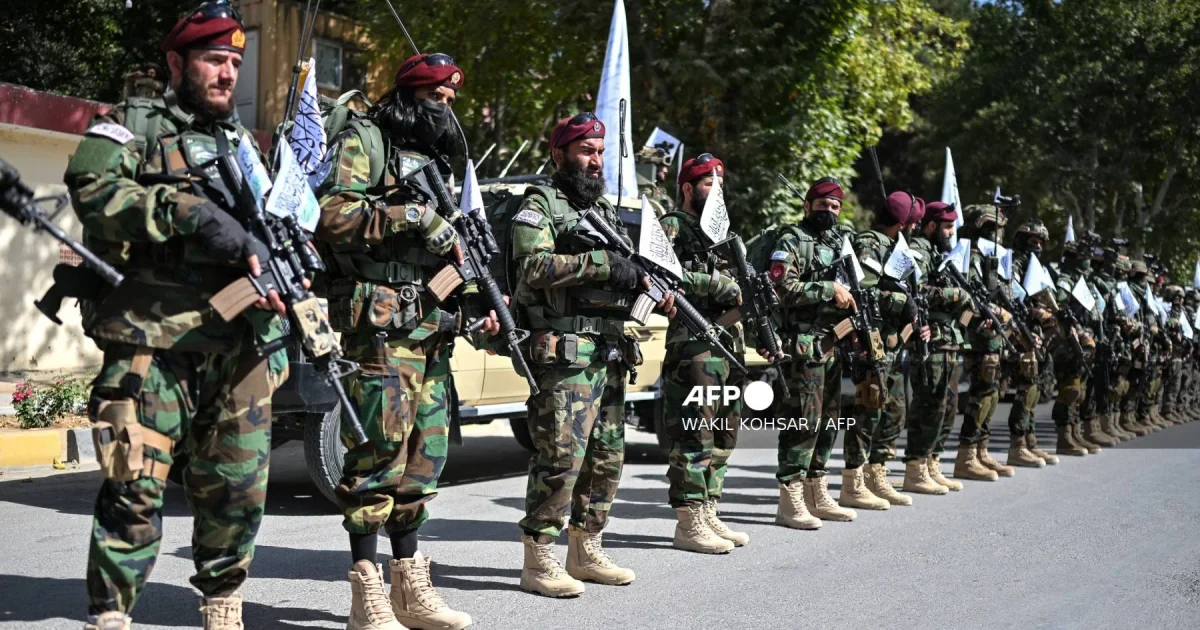
KABUL, Afghanistan — The Taliban government marked five years in power on Saturday with widespread celebrations, including military parades and public gatherings across the capital. Government spokesman Zabihullah Mujahid declared the day would be "written in golden lines in the history of Afghanistan." Afghans decorated vehicles with flags and drove through Kabul, while hundreds gathered near the former U.S. Embassy, waving white Taliban flags.
New murals across the city proclaimed, "Independence is a sign of dignity, pride and identity." Religious and patriotic music filled the air as men and boys participated in the festivities. Military helicopters flew over the capital, and convoys of Taliban security personnel, some in vehicles previously used by foreign forces, paraded through the city. The authorities also announced plans for sports events, including a cricket match, from which girls and women are banned.
The Taliban's return to power occurred on August 15, 2021, following a rapid offensive that led to the collapse of the U.S.-backed government amid the withdrawal of international troops. University student Pirooz Mirzaie, 20, noted that the government has brought security and infrastructure projects, creating opportunities for entrepreneurs. However, he also highlighted the significant challenge of job scarcity for young people.
Government spokesman Mujahid stated earlier this month that the administration is focused on building the economy and urged patience. Despite efforts to establish economic foundations, Afghanistan faces challenges including a decline in GDP per capita. This is partly due to the return of over six million Afghans from neighboring Iran and Pakistan in the past three years. The World Bank has projected real economic growth to reach 4.8 percent.
While Taliban officials have engaged with various countries, including some in Europe, Russia remains the only nation to officially recognize their government. Relations with neighboring Pakistan have deteriorated significantly, leading to conflict this year. This, coupled with international aid cuts, has worsened the humanitarian crisis in Afghanistan.
The United Nations has reported that people are suffering "very real harm" due to the current situation. Fiona Frazer, the human rights director for the UN mission in Afghanistan (UNAMA), described the "consolidation of suffocating restrictions that intrude on almost every aspect of their daily lives, and their human rights." The Committee to Protect Journalists has criticized the authorities for the "brutal repression of the press," detailing instances of media workers being surveilled, detained, beaten, censored, or forced into exile.
Women have been disproportionately affected by Taliban policies. They are banned from public spaces like parks and most employment opportunities. Education for girls beyond the age of 12 is also prohibited. A 23-year-old woman, speaking anonymously for security reasons, expressed a "profound sense of suffocation," feeling as though she had aged decades in the past five years.
Comments (0)
No comments yet. Be the first to share your thoughts!
Leave a Comment